Does the Logitech G923 work on a Mac?
 InputConfig is completely free on the Mac App Store. You don't have to make an account, there are no subscriptions, and nothing is locked. Optimized for Apple silicon.
Yes, both models, read two different ways. Logitech sells two: one for PlayStation and PC, and one for Xbox and PC. The PlayStation and PC model reaches the Mac as an ordinary USB device, and InputConfig, the free app I make, reads its wheel, pedals and buttons in full.
The Xbox and PC model starts in Xbox mode, which is not a standard USB device, so InputConfig reads it through macOS racing wheel support instead, numbered like the G29. The hub tells you which one you have.
On this page
Steps
- Check the hub: PlayStation buttons mean a plain USB wheel, Xbox buttons mean InputConfig reads it through macOS racing wheel support.
- Plug the pedals into the wheel base, then connect power and USB.
- Turn the wheel and press each pedal in InputConfig's Live Visualizer.
- Turn on One-Stick Driving with Steer axis 0 and Throttle axis 5, and lower the deadzone.
- Put the brake and the buttons on rows of their own with Scan.
Find out which G923 you have
Look at the hub. The PlayStation and PC model has the PlayStation buttons, Cross, Circle, Square and Triangle, and shares its rim and hub layout with the older G29. The Xbox and PC model has A, B, X and Y and the Xbox button. The box and the label under the base say the same thing.
| Model | What the Mac sees | InputConfig |
|---|---|---|
| G923 for PlayStation and PC | A standard USB HID device, no driver | Read in full: steering, three pedals, every button, the shifter |
| G923 for Xbox and PC | A wheel in Xbox mode, not a HID device, which macOS racing wheel support reads | Read through macOS racing wheel support, numbered like the G29 |
The Logitech G920 is in the same position as the Xbox G923: it starts in Xbox mode, and InputConfig reads it the same way. The buttons on the hub tell you which way InputConfig reads it.
Connect the PlayStation and PC model
- You: Plug the pedals into the wheel base, then connect the power supply and the USB cable, with a USB-C adapter on a MacBook.
- macOS: Reads it with no driver and lists it under USB in System Information.
- Check: It is listed there. It does not appear under Game Controllers in System Settings, which only lists gamepads.
InputConfig reads it on the same plan as the G29, which is how open-source wheel drivers read it too:
- Steering. Across 900 degrees, at full resolution.
- Gas, brake and clutch. On separate axes, each 0 released and 1 floored.
- Buttons and shifter. Every button on the hub by its printed name, the paddles, the red dial as one press per click, and the Driving Force Shifter's gears when it is plugged into the base.
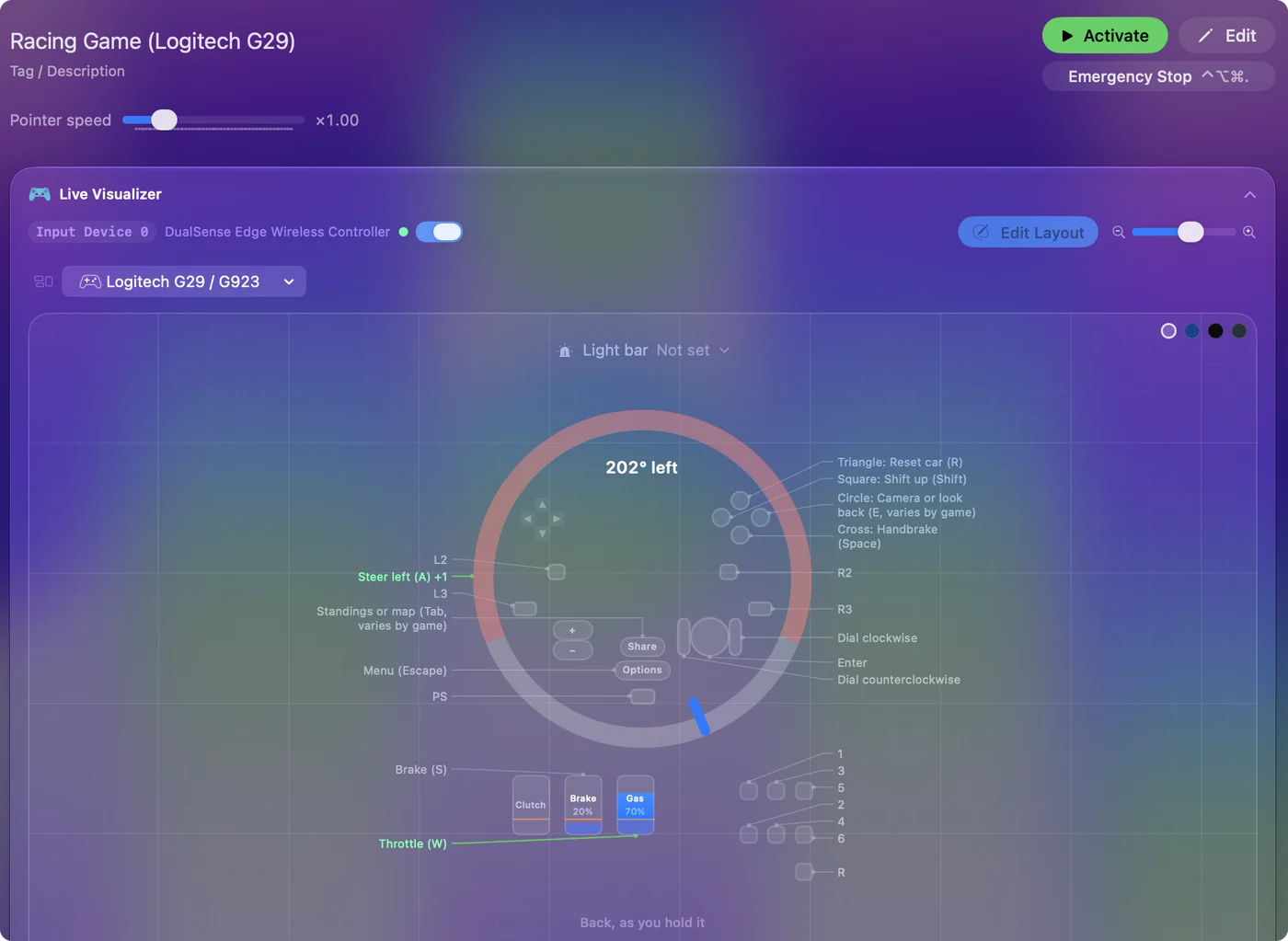
I have not checked every button against a real G923. Press each one in the Live Visualizer before you rely on it. The visualizer draws the wheel, pedals and shifter, labeled G923 for PlayStation and PC, and shows how far the wheel is turned in degrees.
Set it up to drive
The setup is the same as for a G29, and the G29 page walks through it step by step. In short:
- Throttle and steering. In a preset, turn on One-Stick Driving, choose Custom, set Steer axis 0 and Throttle axis 5, and turn on Throttle axis is a trigger (rests at one end).
- Deadzone. Bring it down to a few percent so the car steers within the first few degrees of a 900 degree wheel.
- Brake. Put axis 4 on its own row with Scan.
- Paddles and buttons. On rows of their own.
Logitech's G HUB app has a Mac version. Nothing here needs it, but check Logitech's page for your model if you want its own settings. The low deadzone is what makes a 900 degree wheel feel right.
What the Xbox and PC model can do
A wheel in Xbox mode speaks Microsoft's own protocol, not standard HID, so apps that read USB devices directly do not see it. macOS racing wheel support does, and InputConfig reads the G920 and the G923 for Xbox through it.
- Numbered like the G29. Wheel presets made on a G29 work on them, and InputConfig shows their own button names and the shifter's gears wherever controllers are listed. Their drawing in the Live Visualizer is hidden as experimental.
- Held only while in use. Apple's support gives a wheel's input to one app at a time, and InputConfig holds the wheel only while a preset, the editor or the Live Visualizer reads it.
- The games. Apple named the G920 when it added racing wheel support in macOS 13, so a Mac game written for that support may read a G920. Check a game's supported wheels before you count on either model.
Either model maps to keys with InputConfig: the PlayStation one as a plain USB device, the Xbox one through macOS.
What it cannot do
- TRUEFORCE and force feedback. Not driven. InputConfig sends keys and mouse movement, so with the wheel mapped to keys the motor gives no resistance.
Force feedback on a Mac only comes from a game that drives the wheel itself.
The short version
- PlayStation buttons. It works: plug in, check the Live Visualizer, set up One-Stick Driving.
- Xbox buttons. It works too, through macOS racing wheel support, numbered like the G29.
Look at the hub first, because it decides how the wheel is read.
Questions
Does the G923 work on a Mac?
The PlayStation and PC model does: the Mac reads it with no driver, and InputConfig reads its wheel, pedals and buttons. The Xbox and PC model starts in Xbox mode, and InputConfig reads it through macOS racing wheel support instead.
Does TRUEFORCE work on a Mac?
Only if a game drives it. InputConfig does not drive force feedback of any kind.
Is the G923 the same as the G29 on a Mac?
The PlayStation and PC G923 shares the G29's rim and hub layout, and InputConfig reads it on the same plan. The Xbox G923 is read through macOS racing wheel support and numbered like the G29 too.
Can I switch an Xbox G923 to a mode the Mac can read?
You do not need to. It starts in Xbox mode, and macOS racing wheel support reads it there, which is how InputConfig reads it too. A Mac game still has to be written for that support to read it itself.
Related
This page in other languages: 日本語, Русский
Updated